Tax-Free Savings Accounts in South Africa: How They Actually Work
Published 12 September 2026 · RunYourNumbers
What a tax-free savings account actually exempts you from
A tax-free savings account (TFSA) does one specific thing: any interest, dividends, or capital gains earned inside it are never taxed, no matter how large the account grows or how long you hold it. You still fund it with money you have already paid income tax on, a TFSA is not a deduction like a retirement annuity contribution. The exemption applies only to what the account earns after that, not to the money going in.
That distinction matters because a TFSA is a wrapper, not an investment on its own. The tax break is identical whether the money inside sits in a bank account earning interest or a unit trust invested in shares. What changes the outcome is what you choose to hold inside the wrapper, and that choice is where most of the confusion about TFSAs actually comes from.
The two limits that matter, and why exceeding them is expensive
You can contribute up to R36,000 in a tax year and R500,000 over your lifetime across every TFSA you hold, even if they are at different banks or providers. Both limits are tracked by SARS at an individual level, not per account, so opening a second TFSA at a different institution does not give you a second allowance.
Contribute more than the limit in either measure and SARS charges a 40% penalty tax on the excess, on top of any tax you would have paid on that money anyway. There is no way to undo an over-contribution once the tax year has passed, so it is worth checking your total across all providers before making a contribution close to either cap.
The part that catches people out most is that withdrawing money from a TFSA does not restore the contribution room you used. If you have contributed R400,000 over the years and then withdraw R100,000, your lifetime limit is still R500,000 minus the R400,000 you originally put in, not minus R300,000. A TFSA rewards leaving the money in, withdrawing and re-depositing quietly burns through your lifetime allowance twice.
Two ways to hold a TFSA: fixed deposit or unit trust
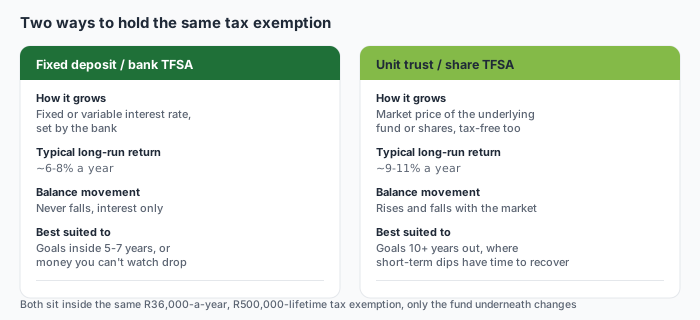
A fixed deposit or bank TFSA works like an ordinary savings account: you deposit money, the bank pays a set or variable interest rate, and the balance only ever moves upward. It behaves exactly like the interest-bearing accounts you already understand, the only difference is that none of the interest is taxed.
A unit trust or share-based TFSA, usually opened through an investment platform or brokerage rather than a bank, invests your contributions in a fund, equity, balanced, or income-focused, and the balance tracks the market value of that fund. It can fall as well as rise in the short term, but has historically produced higher long-run returns than a fixed deposit, and every rand of that growth is just as tax-free.
Which structure suits which goal
If you need the money within five to seven years, or you would lose sleep watching the balance dip in a bad month, a fixed deposit TFSA removes that risk entirely. The trade-off is a lower ceiling on what the tax exemption is actually worth to you over time, since there is less growth for the exemption to apply to.
If your horizon is genuinely long, ten years or more, a unit trust or share-based TFSA lets the tax exemption compound on a higher return, and the extra decade or two gives short-term market dips time to recover before you need the money. Using a long time horizon to absorb short-term volatility, rather than picking the riskiest fund available, is what actually makes the equity option worth the extra uncertainty.
Worked example: same contributions, two structures, twenty years later
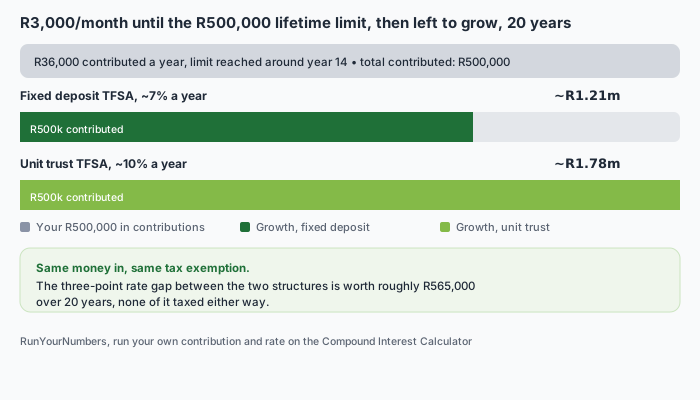
Say you contribute R3,000 a month, R36,000 a year, which uses up your annual allowance exactly. At that pace you reach the R500,000 lifetime limit around year 14, after which you stop contributing (you have to) and simply leave the balance to keep growing for the remaining years to the 20-year mark.
In a fixed deposit TFSA earning roughly 7% a year, that R500,000 in contributions grows to approximately R1.21 million by year 20. In a unit trust TFSA earning roughly 10% a year over the same period, the same R500,000 in contributions grows to approximately R1.78 million. The gap, roughly R565,000, comes entirely from the rate difference between the two structures, since the contributions, the timing, and the tax treatment are identical in both cases.
That gap is also the clearest illustration of why the structure you choose inside a TFSA matters more, over a long enough horizon, than the tax exemption wrapped around it. The exemption is worth more the more the account grows, so a higher sustainable rate multiplies the value of the tax break itself.
Using the compound interest calculator to project your own TFSA
Run your own contribution amount and an honest rate assumption through the Compound Interest Calculator to see where your TFSA is actually headed, rather than relying on a generic example. Set the monthly contribution to whatever you can commit to consistently, the rate to a figure you can defend for the structure you have chosen (mid-single digits for a fixed deposit, historical fund averages minus fees for a unit trust), and the term to your real time horizon.
Then stress-test it the same way you would any other long-term projection: run the unit trust scenario again at two or three percentage points lower, since equity returns vary meaningfully year to year even when the long-run average holds. If the lower estimate still gets you close to your goal, the plan is reasonably robust. If it falls well short, that is a sign to either extend the timeline or reconsider the mix of structures you are using.
Common mistakes with tax-free savings accounts
Treating a withdrawal as reversible is the most expensive mistake, since the contribution room it used is gone permanently, regardless of whether the money ever goes back in. Before withdrawing from a TFSA for anything short of the goal it was meant for, check whether a different account (one without a lifetime limit attached) can cover the need instead.
Putting a long-term TFSA into a fixed deposit purely for the comfort of a balance that never drops is the second, quieter mistake. Over 15 to 20 years, the lower return can cost far more in foregone growth than the short-term volatility of a unit trust would have cost in temporary dips, particularly once the size of the tax exemption on that extra growth is accounted for.
Ignoring platform and fund fees inside a unit trust TFSA is the third. A fund advertising an 11% historical return with a 1.5% annual fee behaves like a 9.5% fund in practice, and that difference compounds the same way any other rate difference does. Check the total expense ratio before assuming the advertised return is what you will actually earn.
Want to see this in action? Try the Compound Interest Calculator.
Keep reading
Frequently asked questions
What is the contribution limit for a tax-free savings account in South Africa?
R36,000 per tax year and R500,000 over your lifetime, both tracked across every TFSA you hold at any institution, not per individual account. SARS charges a 40% penalty tax on any amount contributed above either limit.
Does withdrawing money from a TFSA free up contribution room?
No. Your lifetime limit is based on total contributions ever made, not your current balance. Withdrawing R50,000 does not give you R50,000 of new room to contribute, the amount you originally put in still counts against your R500,000 lifetime limit.
Should I choose a bank TFSA or a unit trust TFSA?
It depends on your time horizon. A fixed deposit or bank TFSA suits money you need within five to seven years, since the balance never falls. A unit trust or share-based TFSA suits a horizon of ten years or more, where a higher historical return has time to outweigh short-term market dips.
Is a tax-free savings account the same as a retirement annuity?
No. A retirement annuity contribution reduces your taxable income now but locks the money away until retirement age, with tax due on withdrawal. A TFSA gives no upfront tax deduction, contributions are made with after-tax money, but growth inside it is never taxed and the money can be accessed at any time.
Can I have more than one tax-free savings account?
Yes, you can hold TFSAs at multiple banks or investment platforms at the same time. Your R36,000 annual and R500,000 lifetime limits still apply across all of them combined, so opening a second TFSA does not increase how much you can contribute in total.